What is a cabin, exactly?
It’s not a precisely defined style but there are a few generally agreed upon descriptors: rustic, rural, simple, and a refuge from the routines and distractions of everyday life. Size is also a consideration. Noted “cabinologist” Dale Mulfinger defines cabins as being between 250 and 1,200 square feet.
Yet material may be the real distinguishing trait. Wood is inseparable from cabins as both a practical building resource and a source of warmth, texture, scent, and visual connection to the landscape—softening interiors, inviting touch, and creating a sense of comfort and informality.
Designed by Fieldwork Design & Architecture, Dry Creek Cabin in White Salmon, Wash., checks all the above boxes but boasts a couple of surprises, including a traditional Japanese hinoki soaking tub, an open-air dogtrot inspired by the Columbia River Gorge’s slot canyons, and a spa wing that connects to an outdoor hot tub and cold plunge.
At 1,200 square feet, the residence also falls at the upper end of Mulfinger’s cabin scale.
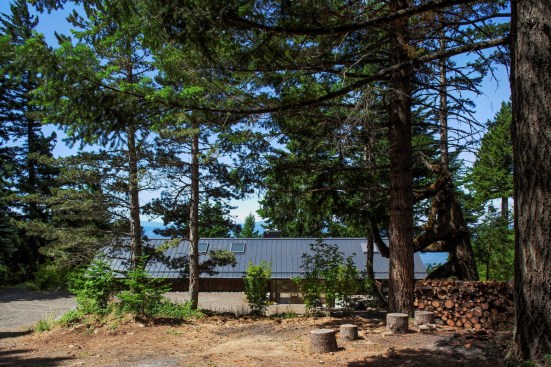
Dry Creek Cabin in White Salmon, Washington, by Fieldwork Design & Architecture. Photo by Dana Klein.
“It’s small. It’s a true cabin,” says Cornell Anderson, principal and architect at Portland, Ore.–based Fieldwork.
Also giving a sense of cabin-ness? A regional wood pallet that connects the structure to the surrounding landscape.
A Material Connection to Place
The cabin occupies a sloping property on the Washington side of the Columbia River Gorge, with views toward Mount Hood and west through the gorge. Set into the hillside, the low-slung structure features a shallow roofline that appears to float just above the grade and allows the cabin to recede into the landscape. The eastern end of the region is drier than the waterfall-rich landscape farther west, and Fieldwork wanted the material palette to reflect those particular conditions.
“In all of our projects, we try to use local resources as much as we can, and we try to make it as specific to the site and hyperlocal as we can,” Anderson says.
Western red cedar clads the primary exterior surfaces. Because the cabin sits in a wildfire-prone area, the architects paired the wood siding with a metal roof and charred the cedar to provide some additional fire resistance.
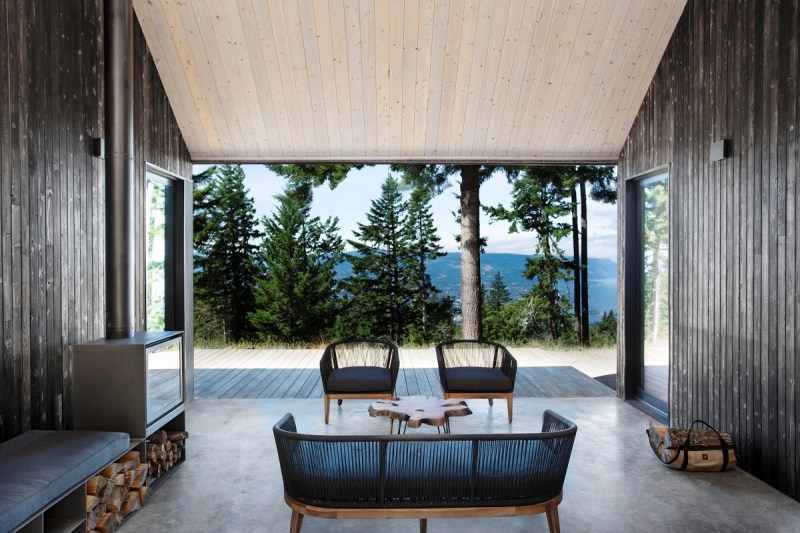
Inside, the palette changes to locally sourced lodgepole pine, a species associated with the semi-arid eastern gorge. It appears on ceilings, casework, kitchen surfaces, a loft screen, and the large sliding screen that secures the seasonal home when the owner is away.
“It has some knots, it has some character, which we like, especially given that everything else is so minimalist and clean,” Anderson says of the lodgepole pine. “We like that contrast.”
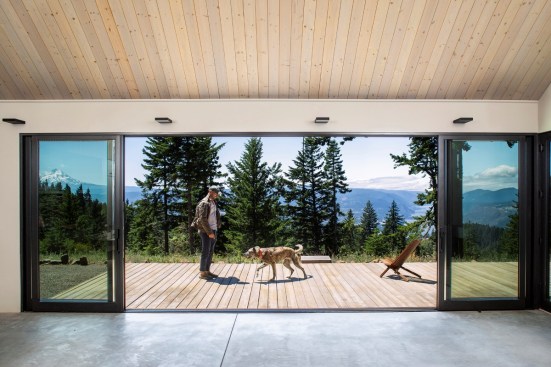
Dry Creek Cabin in White Salmon, Washington, by Fieldwork Design & Architecture. Photo by Dana Klein.
Toning Down the Pine
Untreated lodgepole pine, however, can have a pronounced yellow color that may intensify with time. The team experimented with several finishes, including a pale white treatment, before choosing a gray wash.
“Somehow when we got to more of the gray wash, it was feeling much more natural — almost like it had been naturally sun bleached,” says Tonia Hein, Fieldwork principal and interior designer.
The muted treatment reduces the visual jump between the dark, charred cedar outside and the lighter wood within. It’s not conventionally rustic but minimalist and timeless, designed around the client’s appreciation for calm and a seamless relationship between indoors and out.
Fieldwork retained the original structure’s concrete slab, foundation, and retaining wall after determining that the deteriorated wood-framed cabin could not be renovated. Marks left by former bathroom tile remain visible on the concrete wall, preserving an aged patina.
“Because we kept the concrete, it became more important to contrast it with the warmth of the wood,” Anderson says. “And that was really essential in this project.”
Hein sees the materials as complementary rather than oppositional, noting that the pine appears to draw out warm tones already present in the weathered concrete.
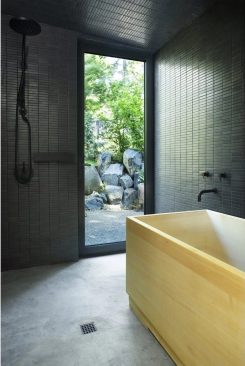
Dry Creek Cabin in White Salmon, Washington, by Fieldwork Design & Architecture. Photo by Dana Klein.
Warmth Beyond Appearance
Wood affects more than the cabin’s visual character. Its tactile surface gives occupants something warmer and softer to encounter than concrete, stone, or glass.
“It softens the space visually,” Anderson says. “It also helps acoustically. It absorbs sound better than a hard surface does.”
Indirect lighting amplifies that softness at night. Rather than exposing the fixtures, Fieldwork concealed the light sources and directed illumination toward the pine ceilings.
“The ceilings just glow with warmth,” Hein says. “You don’t have the harshness of the light kind of directly in your eye. Everything is kind of very soft and indirect.”
The building’s sensory character is especially evident in its spa wing. There, a traditional Japanese hinoki soaking tub reflects the client’s heritage and recalls a familiar ritual from his childhood. Hinoki’s natural resistance to moisture and decay also makes it well suited to the steam room and shower environment.
Along with warmth and texture, the tub contributes scent and memory—qualities that cannot be replicated by a wood-look surface or purely visual finish.
For Hein, the combination of natural materials, a fireplace, and close contact with the exterior creates the comfort and retreat associated with cabins.
At Dry Creek Cabin, the wood palette ultimately supports something less tangible than regional character or visual warmth: an easier, more informal way of being in the building.
“I think [there’s] an informality to it, just the way you can live in the space,” Anderson says. “It’s not too precious. And then that indoor-outdoor connection—nature being so accessible.”
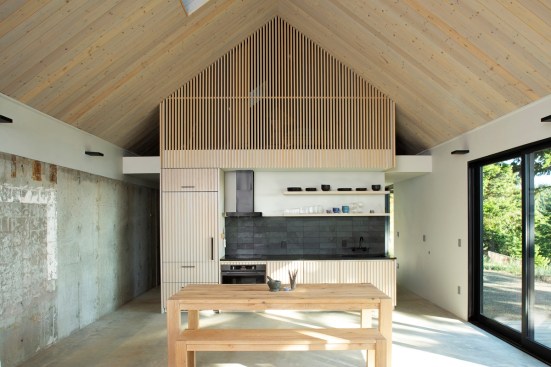
Dry Creek Cabin in White Salmon, Washington, by Fieldwork Design & Architecture. Photo by Dana Klein.
Aging Gracefully
Fieldwork’s use of lodgepole pine follows a long tradition of grounding retreats in the forests around them. Take the Northern California coast, where redwood defines much of the region’s cabin character.
Although Fieldwork did not specify redwood in the Dry Creek project, Anderson says the species exhibits many of the qualities the firm looks for when selecting exterior materials.
“When sourced from responsibly managed forests, redwood is a great choice because of its natural durability, dimensional stability, and resistance to decay and insects without chemical treatments,” Anderson says. “It also weathers beautifully, developing a soft patina over time that works especially well in natural landscapes and creates a warm, timeless atmosphere.”
In cabin architecture, materials are often expected to become more connected to their surroundings as they age rather than remain pristine.
“Much of our work focuses on creating buildings that age gracefully and connect to their surroundings through honest, durable materials,” Anderson says. “Redwood aligns well with that philosophy.”