The future of the city has rarely felt so technologically sophisticated—or so uncertain.
Artificial intelligence promises to optimize urban systems. Sensors measure everything from traffic to air quality. Digital twins replicate entire neighborhoods. Buildings grow smarter, cars edge closer to driving themselves and algorithms increasingly determine how people move through, consume and experience cities.
And yet many of the most basic urban problems remain stubbornly analog: housing is unaffordable, public space is contested, extreme heat is intensifying, social isolation is increasing and political divisions are shaping decisions about who gets to live where—and under what conditions.
What if the missing urban technology isn’t another piece of software, but imagination?
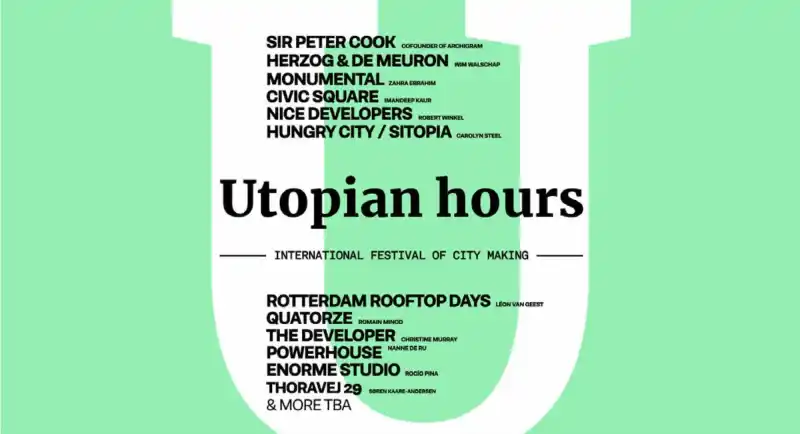
That question hovers over Utopian Hours, the international city-making festival returning to Turin on October 16 and 17 for the second half of its tenth-anniversary edition. Organized by Stratosferica, the two-day gathering at La Centrale Nuvola Lavazza and the nearby Dorado Community Hub brings together architects, activists, developers, planners and urban thinkers around an increasingly radical proposition: cities aren’t finished products to be managed. They are collective projects that can still be reinvented.
The festival’s website describes Utopian Hours as dedicated to “city making”—the ideas, projects and places shaping the future of cities. This year’s Turin edition is expected to bring together more than 30 international speakers, more than 350 Italian administrators and urban practitioners, and 100 city officials from across Europe. Its subjects range from community building and experimental architecture to climate adaptation, future mobility, placemaking, data urbanism and urban AI.
But the most telling word in the festival’s name may still be utopian.
Utopia as a Tool
Utopia has not enjoyed a particularly good reputation in architecture.
The 20th century is littered with the consequences of grand urban visions that assumed architects and planners could engineer better societies from above. Modernism’s heroic plans for towers, highways, megastructures and tabula-rasa redevelopment often proved much more compelling on paper than they did for the communities asked to inhabit them.
Utopian Hours proposes something different. Its utopia is less destination than method: imagining what doesn’t exist as a way of questioning what does.
That distinction seems particularly important as the festival celebrates its first decade.
The anniversary began in May, when Utopian Hours left its Turin home for Rotterdam. The first installment of the Ten Years Edition unfolded at the Groot Handelsgebouw with discussions ranging from gender-inclusive public space and community hubs to climate action, grassroots regeneration and placemaking. It also included tours exploring Rotterdam’s experiments in urban greening and climate adaptation.
Now the festival comes home.
“After witnessing in Rotterdam both the urgency of today’s urban challenges and the extraordinary creativity with which cities are responding to them, we return to Torino with even greater ambition,” says Luca Ballarini, co-founder of Stratosferica. “For part 2 of our Ten Years Edition, Utopian Hours will continue to push boundaries, bringing some of the world’s most radical ideas about cities to our hometown. Because now more than ever, cities are mental weapons.”
That last phrase is provocative, but it gets at something important about the contemporary urban debate. Cities aren’t simply collections of buildings and infrastructure. They are ways of thinking about how society might work.
And few architects have demonstrated the power of that kind of thinking more gleefully than Peter Cook.
Peter Cook Is Still Imagining the City
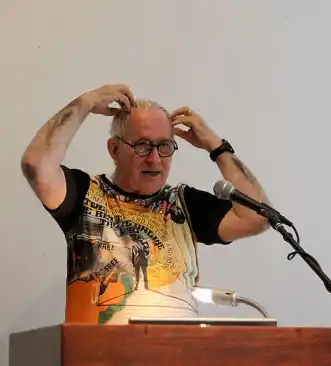
Peter Cook. Courtesy Wikimedia.
Just one week before his 90th birthday, Sir Peter Cook is scheduled to travel to Turin to appear at Utopian Hours.
His presence gives the anniversary an almost perfect historical symmetry.
As a co-founder of Archigram, Cook belonged to the group of young British architects who exploded onto the architectural scene in the 1960s with drawings and provocations that challenged virtually every assumption about what architecture was supposed to be.
Archigram didn’t simply design buildings. It imagined cities that walked, moved, plugged in, expanded, contracted and reorganized themselves around their inhabitants.
Plug-In City proposed an enormous infrastructural framework into which interchangeable components could be inserted. Walking City imagined gigantic mobile structures roaming the planet. Instant City envisioned architecture as a temporary network of information, entertainment and technology descending upon existing communities.
Much of it was deliberately outrageous.
That was the point.
Archigram’s projects functioned as arguments disguised as architecture. Their drawings suggested that buildings didn’t necessarily need to be permanent, cities didn’t need to be static and architects didn’t necessarily need to begin with buildings at all.
Half a century later, those questions feel remarkably current.
Cook’s appearance will be accompanied by an exhibition of drawings associated with him and Archigram at Dorado, where it will remain on view for two months. According to the organizers, many of the works have never previously been exhibited in Italy.
For younger architects accustomed to photorealistic renderings generated with increasingly powerful software, encountering Archigram’s visual universe may offer another lesson: a drawing doesn’t have to predict a building. It can propose an idea.
That makes Cook more than an anniversary headliner. He becomes a bridge between two moments when architecture has found itself wrestling with technology.
Archigram embraced the technological optimism of the Space Age, but it transformed technology into fantasy. Today’s architects face almost the reverse problem: extraordinary technological capabilities coupled with mounting anxiety about what they should actually be used to accomplish.
Perhaps architecture needs to become speculative again.
From the Megastructure to the Messy City
The rest of the announced lineup suggests that Utopian Hours isn’t interested in nostalgia for architectural radicalism.
Instead, Cook’s speculative city will collide with much more immediate questions about how cities are financed, fed, developed and inhabited.
Wim Walschap, CEO and senior partner of Herzog & de Meuron, will represent a practice whose work has repeatedly negotiated between the architectural object and the larger cultural life of the city.
Zahra Ebrahim, co-founder of Toronto-based Monumental, brings an altogether different perspective. Her organization works to build relationships between communities and institutions while embracing what it describes as the productive messiness of urban life—from informal economies to spontaneous placemaking.
That word—messiness—may be one of the more useful ideas in contemporary urbanism.
For decades, planning attempted to eliminate mess. Cities were divided into zones, traffic separated from pedestrians, housing separated from commerce and informal activities replaced with officially sanctioned ones.
But the things that make cities compelling often resist those distinctions.
Street vendors, temporary markets, improvised gathering places, community gardens and unofficial uses of public space frequently reveal needs long before governments or designers recognize them.
The festival’s own history reflects this shift toward smaller, participatory forms of intervention. At its Rotterdam edition, for instance, Slovenian nonprofit urban design studio Prostorož presented projects in which streets become squares, disused buildings acquire new uses and neglected green spaces return to public life through temporary interventions.
The implication is significant: sometimes the future of a city doesn’t need to be built from scratch. It needs to be discovered inside the city that already exists.
What If We Designed Cities Around Food?
Another guest approaches the city through something even more fundamental: eating.
British architect, author and urbanist Carolyn Steel is best known for the concept of Sitopia, derived from the Greek words for food and place.
The premise turns conventional urban thinking inside out. Rather than treating food as one system among many, Steel asks what happens when we recognize that feeding ourselves has always been one of the primary forces shaping cities, landscapes, economies and social relationships.
Food determines where cities emerge, how land is cultivated, how goods move, where markets develop and how people gather. Yet industrial food systems have increasingly concealed those relationships.
Seen through Steel’s framework, the future city isn’t simply an architectural question. It is agricultural, ecological, economic and cultural at once.
That expansive definition of city-making runs throughout Utopian Hours.
The director of Rotterdam Rooftop Days will examine the enormous amount of urban territory hiding in plain sight above our heads, where roofs can become public spaces and infrastructure for climate adaptation. French nonprofit Quatorze will bring its model of solidarity-based architecture. Madrid’s ENORME Studio will contribute its experiments with participatory and transformable design, while Powerhouse Company will address housing, architecture and large-scale urban transformation.
Then there is Nice Developers, whose inclusion carries an intentionally mischievous message: developers don’t necessarily have to be nasty.
That proposition may be more radical than it sounds.
In cities where debates over housing increasingly devolve into battles between development and preservation, Utopian Hours appears interested in dismantling the assumption that the people who finance cities and the people who inhabit them must occupy opposing camps.
Stop Talking. Start Making.
This is where the festival’s structure becomes important.
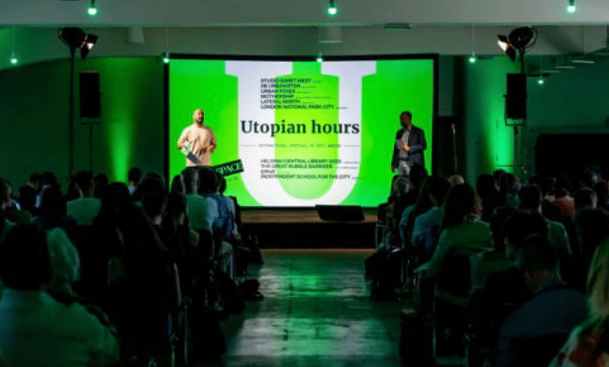
Utopian Hours doesn’t present itself simply as an architecture conference. Keynotes and conversations at La Centrale are accompanied by exhibitions, workshops and working sessions at Dorado.
Its signature roundtables are conceived as participatory sessions where city officials, companies and urban practitioners address specific challenges. The current festival program describes Utopian Hours as bringing together architects and designers alongside administrators, businesses, publishers, independent organizations and city makers.
That mixture reflects a larger change in who gets to claim expertise over cities.
The architect is no longer necessarily the central figure.
Community organizers, developers, policymakers, activists, journalists, data scientists, artists and residents increasingly participate in shaping urban environments. The question becomes less Who designed this? than Who had agency in deciding what this place could become?
Stratosferica’s own manifesto pushes this argument further. Its collection of urban propositions addresses housing, mobility, public space, governance and alternative development models. One recurring idea is that the physical appearance of a supposedly futuristic city matters less than the social and political systems underneath it.
That may also explain why Utopian Hours feels particularly relevant at ten.
The Future City Isn’t Coming
For much of the 20th century, architects drew the city of the future as something waiting over the horizon.
It had monorails.
It had megastructures.
It had flying cars, moving sidewalks, geodesic domes and towers stretching toward the clouds.
The future was somewhere we were going.
Today, the premise is harder to sustain. Climate change isn’t approaching; cities are already experiencing it. Housing crises aren’t theoretical. Neither are migration, loneliness, political polarization, aging infrastructure or inequality.
The future city has arrived—and it looks suspiciously like the city we already inhabit.
That changes the meaning of utopian thinking.
The task is no longer to draw a perfect metropolis and wait for technology to make it possible. It is to identify possibilities hidden inside imperfect cities: an unused rooftop, an abandoned warehouse, a street that might become a square, an informal economy that deserves recognition, a development model that distributes value differently, or a community that already understands what its neighborhood needs.
Even the venues of Utopian Hours embody that argument.
La Centrale Nuvola Lavazza is a former power plant dating to 1897 that has been regenerated as a cultural venue. Dorado, along the Dora River, occupies a former warehouse transformed into an urban innovation and community hub. The festival isn’t taking place inside a speculative city of tomorrow. It is occupying pieces of yesterday’s city and asking what else they might become.
And that brings the story back to Peter Cook.
Archigram became legendary not because it accurately predicted what cities would look like in 2026. It mattered because it expanded architecture’s field of possibility.
At nearly 90, Cook returns to a conversation that increasingly needs precisely that capacity.
The most consequential urban innovation of the next decade may not be autonomous vehicles, artificial intelligence or another smart-city dashboard. It may be something simultaneously simpler and more difficult: restoring our ability to imagine cities differently—and then giving people the agency to change them.
After ten years, Utopian Hours’ greatest provocation may be that utopia isn’t a place at all.
It is permission to believe the city doesn’t have to remain the way it is.