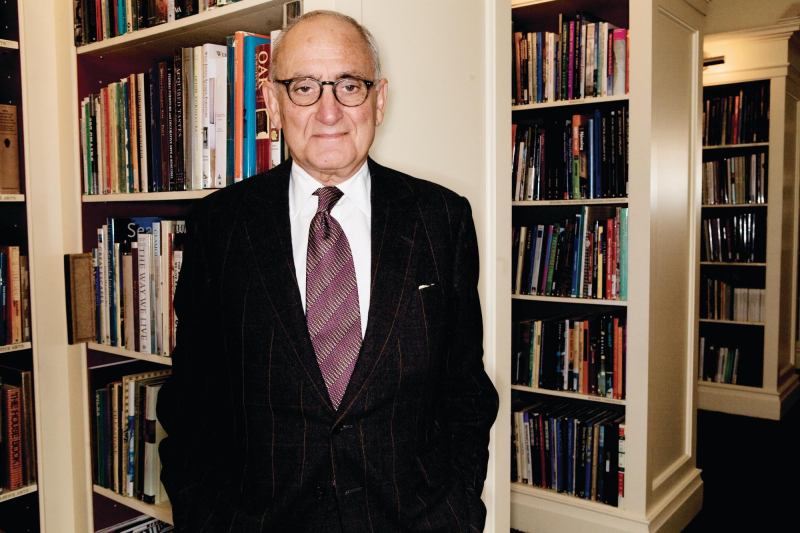
For more than half a century, Robert A.M. Stern occupied a singular place in American architecture. He was simultaneously one of the country’s most successful practicing architects, one of its most influential educators, and one of its most prolific historians. While many architects built careers by rejecting the past, Stern devoted his life to proving that history remained architecture’s greatest source of innovation.
This October, nearly a year after his death in 2025, the Yale School of Architecture will convene architects, historians, critics, and former colleagues to examine that legacy from multiple perspectives. “Putting Architecture in Its Place: Robert A.M. Stern and His Scholarship”, a day-long symposium scheduled for October 17 in New Haven, Connecticut, promises to explore not only Stern’s buildings but also the scholarship that shaped generations of architects and challenged prevailing assumptions about modernism, classicism, and the role of architectural history.
Rather than serving as a memorial, the gathering is intended as a critical examination of an architect whose intellectual influence often extended further than the buildings themselves.
Beyond the Buildings
Although Stern’s firm produced hundreds of projects around the world—including university campuses, museums, private residences, and some of New York City’s most recognizable residential towers—his written work occupies an equally important place within architectural culture.
His multi-volume histories of New York architecture remain standard references for scholars and practitioners alike, documenting the city’s evolution with extraordinary depth while arguing that architecture cannot be understood apart from its cultural, political, and urban contexts.
That commitment to historical inquiry informed virtually every aspect of Stern’s career.
The Yale symposium will focus particularly on this scholarly dimension, examining the ideas that connected his research, teaching, criticism, and design work over more than five decades.
According to organizers, sessions will revisit Stern’s formative years—from his education at Yale to the ideological battles that defined architecture during the 1970s and 1980s—and explore “the long-held convictions that undergirded Stern’s scholarship and built work.”
Those debates proved pivotal in American architecture. As modernism’s dominance began to fracture, Stern emerged among a generation of architects questioning whether history and ornament could once again play meaningful roles in contemporary practice. Unlike many of his contemporaries, however, Stern approached those questions not merely through design but through extensive archival research and writing.
Transforming Yale
The symposium also inevitably revisits Stern’s nearly two decades as dean of the Yale School of Architecture.
Serving from 1998 until 2016, Stern oversaw a period of significant growth that expanded the school’s global profile while reinforcing its reputation as one of the world’s leading centers for architectural education. His tenure emphasized historical literacy alongside experimentation, encouraging students to engage architecture’s past without treating it as a constraint on innovation.
His leadership also broadened Yale’s public role through exhibitions, publications, lectures, and an increasingly international network of scholars and practitioners.
That educational legacy continues to shape the school today.
The symposium has been organized by Deborah Berke, Edward P. Bass Dean and J.M. Hoppin Professor of Architecture, together with Leopoldo Villardi.
A Conversation Across Generations
Reflecting Stern’s wide-ranging influence, the symposium will bring together an unusually diverse group of participants representing architectural history, criticism, design practice, and education.
Among those scheduled to participate are Barry Bergdoll, Joe Day, Melissa DelVecchio, Kyle Dugdale, Mark Foster Gage, Sam Jacob, Níall McLaughlin, Mary McLeod, Eeva-Liisa Pelkonen, M. Surry Schlabs, Robert Simonson, Jennifer Stone, A. Krista Sykes, and Graham Wyatt.
Their discussions are expected to examine Stern from multiple angles—as architect, historian, writer, teacher, and cultural critic—offering a more nuanced portrait than either celebration or criticism alone might allow.
The program will also include optional walking tours of Robert A.M. Stern Architects-designed buildings across the Yale campus, giving attendees an opportunity to experience the built work alongside discussions of the ideas that informed it.
A keynote address and reception will conclude the day’s events.
Reconsidering a Complex Legacy
Few architects inspired stronger opinions than Stern.
To supporters, he demonstrated that architecture could embrace historical precedent without sacrificing originality. His scholarship restored attention to overlooked chapters of American architectural history while his buildings argued for continuity in an era often defined by rupture.
Critics, meanwhile, viewed his traditionalist tendencies as resistant to architecture’s forward-looking ambitions.
Yet regardless of where one stands in those debates, Stern’s influence is difficult to overstate. Through his books, teaching, practice, and institutional leadership, he helped redefine conversations about architectural history and its relevance to contemporary design.
The Yale symposium suggests that those conversations are far from finished.
Instead, it offers an opportunity to revisit the intellectual foundations of a career that consistently challenged the profession to reconsider how history shapes the architecture of the present—and the future.
With attendance expected to be high and space limited, the gathering is likely to become one of the most significant architectural events of the fall, bringing together scholars and practitioners to reassess a figure whose greatest legacy may ultimately lie not only in the buildings he designed, but in the questions he insisted architects continue asking.
“Putting Architecture in Its Place: Robert A.M. Stern and His Scholarship” Symposium
Saturday, October 17, 2026
11:00 a.m.–6:00 p.m.
New Haven, Connecticut
The organizers anticipate high attendance for this event; space will be limited. More details will follow; please indicate your interest here to receive more information: http://architecture.yale.edu/stern-registration