The first time I saw Star Wars’ giant Death Star cruise over my head in the front row of a megaplex in suburban Connecticut I was hooked. Even more thrilling were the spaceship’s interiors, all swoops and drops modulated by machines turned into structures and enveloping you in spaces far beyond gravity.
I was a cynical college kid, so I did not care much for the heroics taking place in those settings, but I gave myself over to a new reality far away in space and time. I have a similar feeling about the terrestrial spaceship that franchise bought.
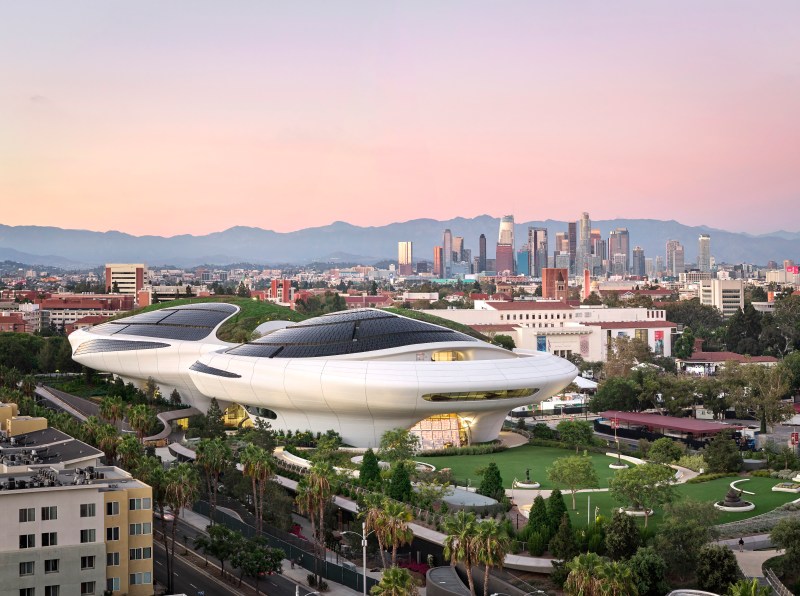
The Lucas Museum of Narrative Art swells, dips, arches, and floats above the landscape, disconnected from current reality. Inside are a few spectacular spaces, mainly for entertainment, and a hangar full of realist art that is even more hackneyed than Lucas’ storytelling.
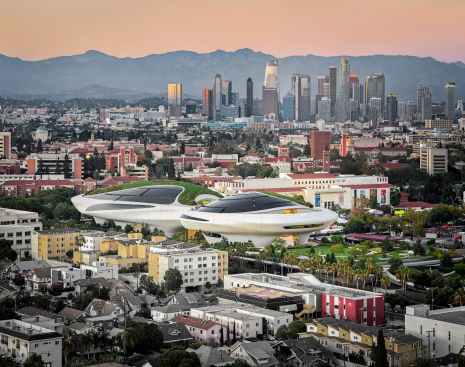
Photo Courtesy Lucas Museum of Narrative Art. Photo by Hufton Crow.
Designed by Ma Yansong’s Beijing-based firm MAD, working with local associate Stantec, the roughly 300,000-square-foot museum contains about 100,000 square feet of galleries. Around it, Mia Lehrer and Studio-MLA have planted an ameliorative 13-acre landscape of gardens, trees, paths, an amphitheater, meadow, and water features that is meant to, but does not really, tie the building to its community. All this cost over a billion dollars to construct, and almost double that to open and endow.
The architecture is, unlike the almost as expensive Geffen Wing of the Los Angeles County Museum of Art, which opened just a few months earlier, good in terms of the object it produces. As is the case in Ma’s best work, the building is a sculpture at a huge scale that barely touches the ground.
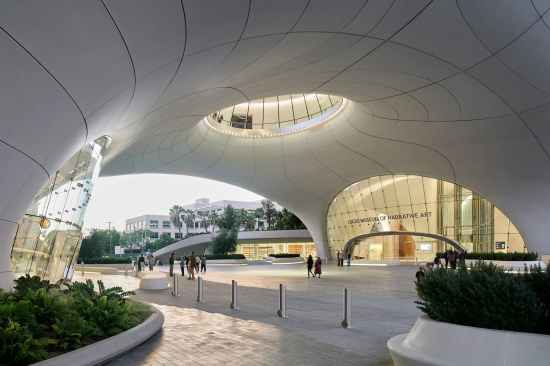
Lucas Plaza. Photo Courtesy Lucas Museum of Narrative Art. Photo by Hufton Crow.
Its skin, composed of more than 1,200 individually formed fiberglass-reinforced polymer panels, stretches across the structure with the little modulation an almost limitless budget can buy. The museum touches down at relatively few points while opening underneath itself to form a public plaza. At its center, an arch spans 185 feet, and an elliptical opening cuts through the mass to the sky.
The building works best where it faces the park. There it lifts of the ground and opens to the public arena. Unfortunately, that leaves long stretches of windowless walls facing the streets and USC’s adjacent campus.
This spaceship faces south and concentrates its goodies into an entrance that calls to mind the maw into which smaller craft land in the Star Wars films. Then again, there is not much left of the multicultural neighborhood Lucas claims to serve: endless swaths of Type 3 housing for students at adjacent USC frame the curves with blocky absence of form.
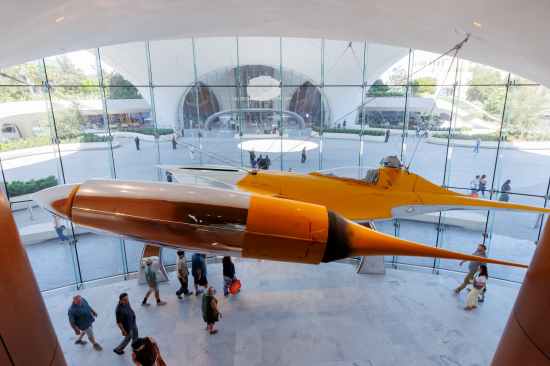
Starfighter. Courtesy Lucas Museum of Narrative Art. Photo by Iwan Baan.
As a building, though, the Lucas is more than ready for its close-up and maybe is a more appropriate monument for Los Angeles than the Geffen. This is a city that, even before the emergence of the movie “industry” has always understood architecture as scenery and scenery as architecture. Here buildings have become signs, mountains are backdrops, freeways sweep along as cinematic tracking shots, and fantasy is continually turned into real estate. Unlike the Swiss precision Zumthor employed to little dramatic effect, Ma’s architecture is one that carries you into its performance.
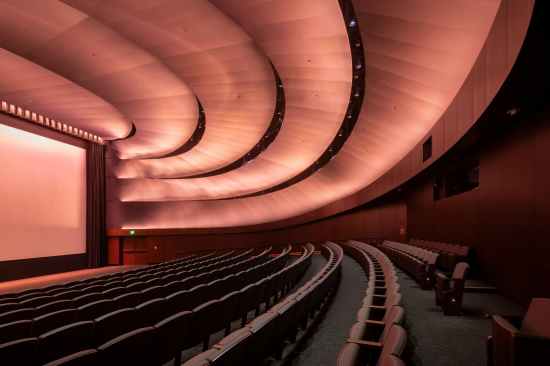
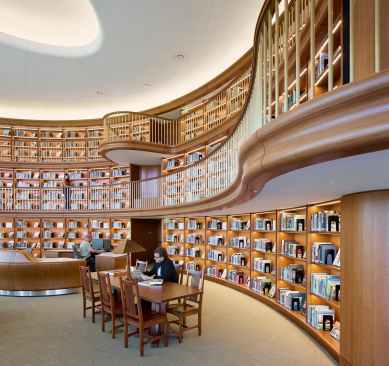
That drama keeps going past the entrance courtyard and its oculus supported by daring cantilevers and through the requisite multi-story lobby and requisite adjacent gift shop, restaurant and not one, but two theaters. Only the grand staircase is missing: you can find it in the smaller wing, where it leads up to a small and voluptuous library.
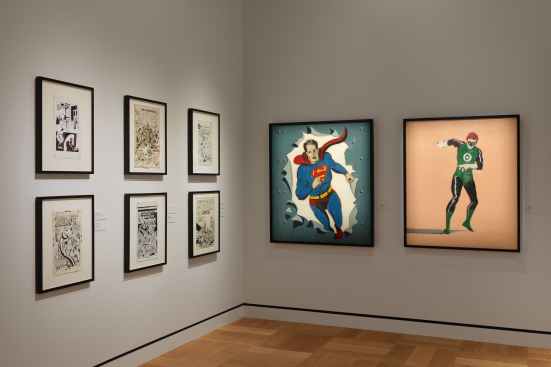
In the main space, you are whisked up into the attic in glass elevators, and then suddenly it is as if the movie reel came off its sprockets. You have arrived in the supposed point of the whole endeavor: almost 100,000 square feet of galleries that take up almost all of the fourth floor, divided into cookie-cutter white-walled rooms under a ceiling of black steel and mechanical systems that have not been art directed (supposedly this area was designed by wHY Architecture, but the firm takes no credit for it on their website).
Courtesy Lucas Museum of Narrative Art. Photo by Paul Salveson.
You reach the display spaces down two symmetrical hallways big enough for a dozen storm troopers to march across and find a bizarrely organized collection of illustration art, bad realist pictures by good artists, and so much mawkish sentiment caught in gilded frames that I felt almost physically ill. It just keeps going, room after room of over 1,300 examples of bad art. The central space, which is where most of the audience huddled at the opening I attended, and which is devoted to the artificially worn and dynamically displayed Star Wars vehicles, costumes, and illustrations, comes as a relief despite its echoes of Disneyland theming.
Only at the edges of all this banality, where curved windows cut into the building’s crown open to views across panoramas of Los Angeles and make the Geffen’s unmodulated continuous windows seem even more useless, does Ma’s architecture come back.
Even better are the luxurious bolt holes where, I assume, Industry Types can come together after the Oscars. Most outlandish is the Skywalker Grill, which envelops you with cherry-wood surfaces, illuminated white onyx Corian, a sculptural bar, and a private dining room with glass that can turn opaque.
Just as the galleries are the white box space drawn out and dressed down to extreme lengths, the spaces for eating, drinking, gathering, screening films, entertaining donors, and looking out over Los Angeles are the museum as social condenser and entertainment machine taken to the other logical end where they are so rich and exclusive as to become another plotline, one devoted to the today’s Senators of the Empire.
Courtesy Lucas Museum of Narrative Art. Photo by Iwan Baan.
Then again, the narrative I have sketched above is a conventional one: the building is good because it has a strong exterior aesthetic that continues into its public space; its main interior is disappointing because that look and feel disappears and another one, which I do not like, appears. I believe I can ground my judgement not only in a critique of the combination of what I think is a demeaning populism behind which a lavish elitism and self-aggrandizement of a person who might make good movies, but seems to have sponsored a monument that displays no discernment in the field of art, hides, but I also full well recognize that the Lucas Museum will without any doubt in my mind be much more popular than the Geffen –which, in the three times I have been there, was nearly empty despite the splash its recent opening made.
Library. Courtesy Lucas Museum of Narrative Art. Photo by Hufton Crow.
If you are willing to accept the premise of narrative art that it is the story and its ability to make us suspend disbelief, not either its originality or its aesthetics, that matters, then the Lucas Museum building is a success as an object that almost, if not quite, lifts off the muddled ground of Los Angeles, a failure as container for storytelling, and then again a success as an unapologetic and bland vehicle for traditional narratives. That also points to the problem with trying to tie architecture to such stories: ultimately the building is real, both in a social and economic sense, and in a physical manner. There are no Jedi mind tricks here. It can never unfold, zoom, dissolve, and rocket away from its mortal coils.