Beyond going to experience OMA’s normalization of the New Museum through their serviceable, bare-bones addition for the architecture, the other and more fulfilling reason to make your way to New York’s Bowery is to see the assemblage of artifacts that the institution’s Chief Curator Massimiliano Gioni has put together to mark the merger of new and old machines for art display.
Called New Humans: Memories of the Future, it traces the ways in which the image, form, and idea of what we think of as, on the one hand, the human and, on the other, that of technological artifacts have become intertwined and interposed. In the exhibition’s view, this situation has been leading us to an uncertain future of humanity that artists, our secular culture’s prophets, predicted over a hundred years ago.
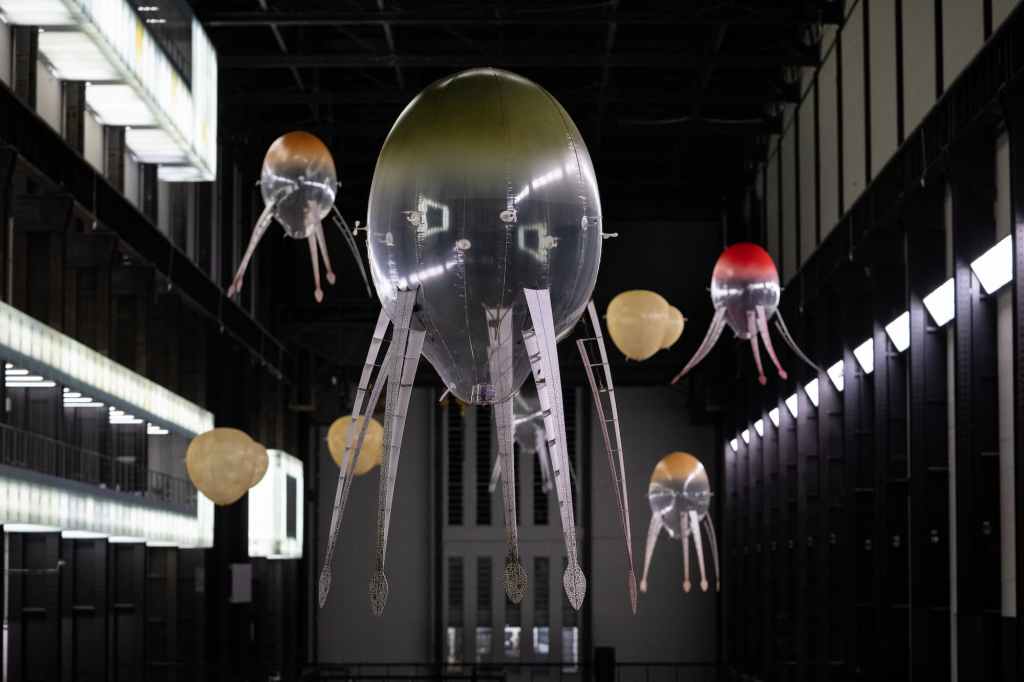
To walk into the New Museum right now is to be overwhelmed by flailing, failing, and fictional bodies. Some of the displays are robots, including Anicka Yi’s alluring In Love with the World (2021/2025), which float above you as advance scouts, perhaps, of an alien invasion, while others are human figures marked by the direct or psychological terrors our technological times.
The exhibition includes devices that do not work but instead make you look at their broken tool quality (as Object Oriented Ontology would ask us to do) so that we might question what essence they are hiding from us. The show is a collection of portraits, still lives, and landscapes, whether urban or natural, in which bodies and artifacts are so mixed up that you lose the perspective of the passive observer.
What you will not find are a lot of pretty pictures. There are also no proposals, at not overtly, as to what to do with all that machinery. Gioni is not interested in either utopias or dystopias. Instead, he says in a catalog as big as the exhibition (I wrote one of its essays), his purpose is “interrogating the myths and histories of contemporary technology, searching for their roots in the dreams that anticipated the realities.”
As a result, “the exhibition also highlights the troubling parallels between the spread of modern forms of fascism, drawing attention to technologies key role in both instances, particularly as it relates to propaganda and disinformation.”
A clear agenda, thus, for an experience that is one more overwhelming that satisfying. Individual pieces might make us wonder or be afraid, but the overall effect is to immerse you in a century’s worth of art in a manner that reminded me of the experience of going to a hospital, from the agony of the bodies you encounter there to the tools and technologies, most of a mysterious nature, that surround you, all in the framework of an environment that wants to give you the sense of normalcy but only increases you profound doubts about your body and mind (a world evoked, although more from the medical staff’s perspective, by Yuri Ancarini’s video Da Vinci (2012).
That is not to say that beauty is lacking. Especially in the older material, such as Francis Picabia’s, Constantin Brancusi’s and Marcel Duchamp’s visions of bodies, machined surfaces, and larger, factory-like constructs merging in delicate hues and finely honed forms, the idea that we were refashioning ourselves into cyborgs seems like an attractive promise.
With Rudolf Laban’s dance notational system, its dots and dashes presaging the oddly absent John Cage’s scribbles, the fusion of mechanics and bodies becomes real. By the time you get to the 21st century, the giant sucking sound of the Internet has produces continually morphing assemblages. They are presaged by pioneering works such as Donald Rodney’s Autoicon from the 1990s that were and still are exhilarating.
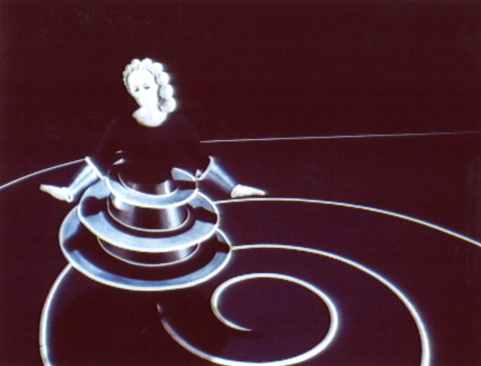
Oskar Schlemmer.
Yet very early on the horror also shows within the promised. From Max Ernst’s collages of bodies, monsters, and tools to Karel Appel’s and Edward Paolozzi’s screams against or in the machine from the 1960s, to Hito Steyerl’s Mechanical Kurds of 2025, or Ivana Blasic’s Blossoming Humans of the same year, turns out the be short (d)evolution. In these images and forms, bodies are tortured fragments invaded by real or pixel-based landscapes, leaving little sense of coherence of salvation.
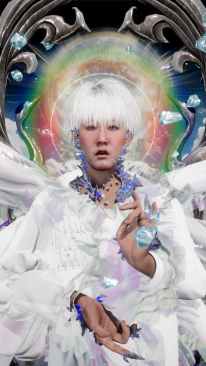
LuYang.
Gioni does not want to think linearly, and so, as you wander the galleries, you encounter the monsters and the angels, such as LuYang’s DOKU Heaven – God Mode (2024) of technology in turns. There are even visions of places in which the merger of human beings and the tools they have made might make some sort of sense.
The exhibition includes several of Raymond Hood’s drawings of a Metropolis of Tomorrow. Here skyscrapers have grown together into a mountain landscape as awe-inspiring as the Alpine one that gave rise to the definition of the sublime.
There are also several models by Constant, who spend over two decades, from the 1960s to the 1980s, imagining a New Babylon in which we would be free to wander –as mergers of human and human and human and machine– in a technology-enabled freedom.
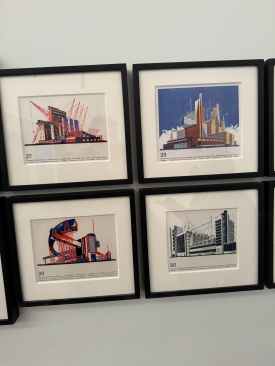
Ivan Chernikov.
Gioni shows how such visions were presaged by Ivan Chernikov’s Fantasy Architecture, a reaction to the hope engendered by the Russian Revolution and have continued in unlikely places such as the funerary version of Kinshasa of Bodys Isek Kingelez’s 1990s Ghost Town.
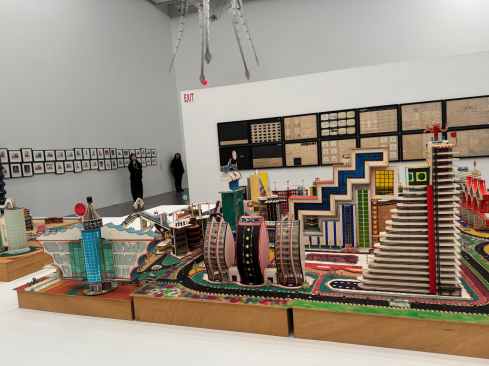
Kinshasa of Bodys Isek Kingelez’s 1990s Ghost Town.
Rather than despairing at our loss of body and even humanity, such projects suggest that dissolving ourselves into a greater community that might be part human and part machine, might be fun and even good. Beyond that, New Humans hints that we should realize that we question even our defining borders.
If we just use the tools of technology or art (or both) to change our perspective, we might realize that the biological organisms that make up most of our body as well as forming the majority of the real landscape around us, are part and maybe the majority of who we are.
The quest or question is thus not, as the exhibition’s title might imply, to look for new definitions of humanity and its constructs informed by a century of technology, but to realize that what that machinery has allowed us to do is to realize, in both sense of that world, our constitution.
This was what I experienced as the power of New Humans: art and architecture doing their job of making us see ourselves and our world in a manner that does not answer doubts, but lets us go wander, in both terror and hope, through perhaps even post-human possibilities.
Read more: The latest from columnist Aaron Betsky includes reviews of:The Shakers | The V&A Storehouse | Fins on Buildings | New Museum & The Studio Museum in Harlem | The Modern Museum | Monuments | Infrastructure | Interior Design | Viollet-le-Duc | Malibu High School | Architecture without Architects | Louis Kahn’s Fisher House | Meow Wolf | Generative AI | Frank Gerhy | Robert A.M. Stern | Lars Lerup | Princeton Art Museum | Victor Legorreta | Mexico City Underwater | On Vitruvius | On Olive Development | Calder Gardens | White House and Classical Architecture | Louis Kahn’s Esherick House | Ma Yansong’s Fenix Museum | The Cult of Emptiness | An Icon in Waiting | Osaka Expo | Teamlab | the Venice Biennale of Architecture | On Michael Graves | On Censorship or Caution? | Uniformity in Architecture | Book on Frank Israel | Legacy of Ric Scofidio| Fredrik Jonsson and Liam Young | DSR’s New Book | the Stupinigi Palace | Living in a Diagram | Bruce Goff | Biopartners 5 |Handshake Urbanism | the MONA | Elon Musk’s Space X | AMAA | DIGSAU | Art Biennales | B+ | William Morris’s Red House | Dhaka | Marlon Blackwell’s new mixed-use development | Eric Höweler’s social media posts,| Peter Braithwaite’s architecture in Nova Scotia,| Powerhouse Arts, | the Mercer Museum, | and MoMA’s Ed Ruscha exhibition.
Keep the conversation going—sign up to our newsletter for exclusive content and updates. Sign up for free.