Why look at luscious textures assembled with skills that are almost unbelievable into shapes that are so distorted that they defy the sense that they came out of any kind of organic or mineral reality? Because they are an answer to both the reductive minimalism mandated by a combination of capitalism’s leeching of value out the making process, the need to be Instagramable, and the opposite ability of AI to imagine, but not make, anything.
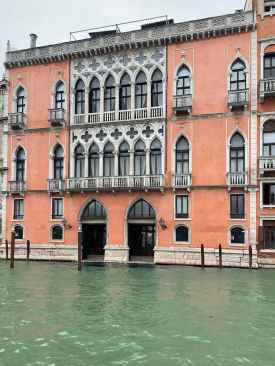
Fondazione Dries Van Noten at the Palazzo Pisani Moretta.
That is why it is worth going to immerse you in other possible worlds that are so real you can scarcely believe them in The Only True Protest is Beauty, an exhibit curated by Geert Bruloot and the Belgian fashion designer Dries van Noten in the Palazzo Pisani Moretta, a Rococo confection on Venice’s Grand Canal now occupied by the latter’s namesake foundation.
The exhibition is also the standout, ascertained by buzz and the difficulty of obtaining tickets, in this year’s notably lowkey Venice Art Biennale, which is aptly named In Minor Keys. With the exception of the success de scandale of the big-breasted women-filled Austrian Pavilion (which was impossible to visit even during the preview days), this year’s event lived up to its name, with even the usual parties being fewer.
The Van Noten Foundation exhibition’s achievement is to give intensity to the main event’s concentration on art-making over statement-making and to indeed argue that beauty, however weird, is a revenge against the morass of ugliness surrounding us in all aspects of our daily lives. Despite the roots of that statement in a protest song by the 1960s troubadour Phil Ochs, however, this retreat into intensity does not comment, let alone do anything about, the root social, political, and technological causes of the End of Days atmosphere surrounding the Palazzo.
Nor do Bruloot and van Noten pretend that is what they want to do. “Here centuries of mastery serve as a backdrop for new dialogues between art and artisans, past and present,” the brochure for the exhibition says. The area where that argument is proven most clearly, naturally, is in the realm of fashion –although van Noten, thankfully, is careful not to highlight his own designs.
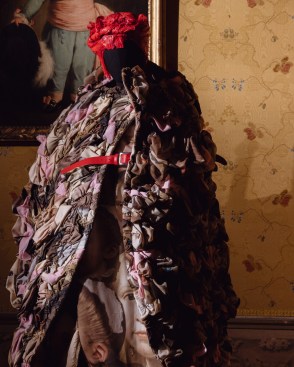
Comme des Garçons Collection Spring/Summer 2024 Headpiece by Julien d'Ys Courtesy of Comme des Garçons.
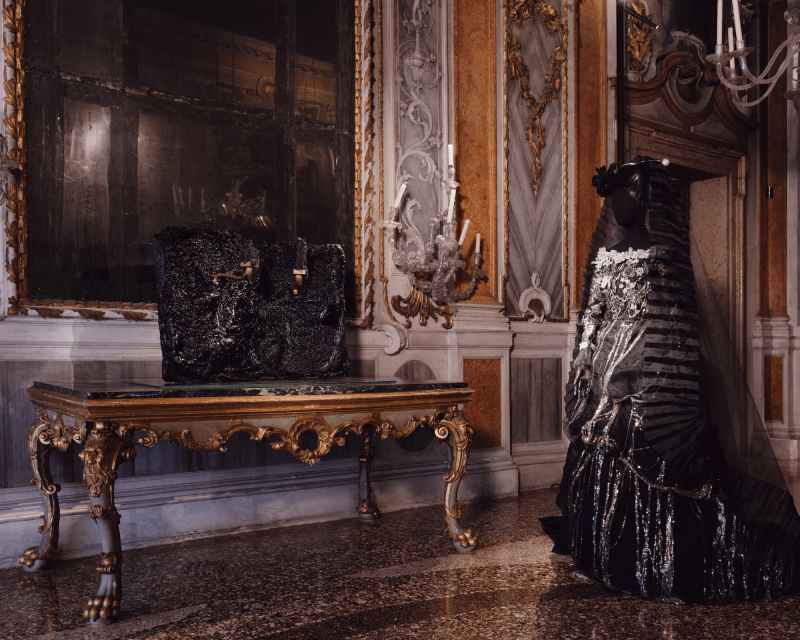
Instead, he filled almost every room with examples of pieces by Christian Lacroix and Comme des Garçons. The latter gives us shapes we might recognize from centuries of dress making layered in fabrics with so much pattern and encrusted with so many beads and costume jewelry to make them almost unrecognizable. Comme des Garçon’s Rei Kawakubo shows us satyrs, chimeras, and other hybrid creatures that thoroughly deform the human form. Kawakubo carries these pieces out in found material, scraps of fabric, and even what appear to be garbage bags. They bulge, protrude and swirl around, echoing not so much the history of couture as the 18th century decorations that cover almost every surface of this early 17th century palazzo.
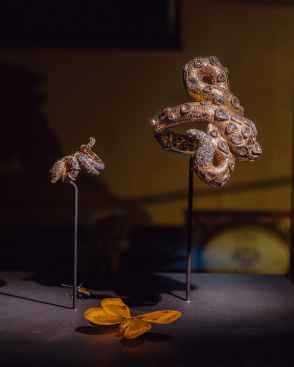
A.Codognato. Serpent bracelet 18-karat yellow gold and silver, diamonds. Courtesy of Collection of Cathy Vedovi. Photo: Matteo de Mayda.
The interest in the transformation of the human body through craft continues in collections of jewelry, notably by the local firm founded by Attilio Codognato (who gets credit as an artist in the checklist, even though the fashion designers do not). A “bijou jewelry emporium” founded in 1865, it has supplied both the fashion industry and celebrities since then, but van Noten has chosen the pieces that are memento mori: skulls and skeletons dancing between the precious stones.
You can almost see the film Death in Venice, with its aqueous mixture of death and decay, reflected off its surfaces (the movie’s director, Luchino Visconti, was a Codognato client). The skill with which the pieces was assembled is matched by their sense of them being purposefully too much, making you both in awe and uncomfortable at the same time –and not just because of the hints of mortality.
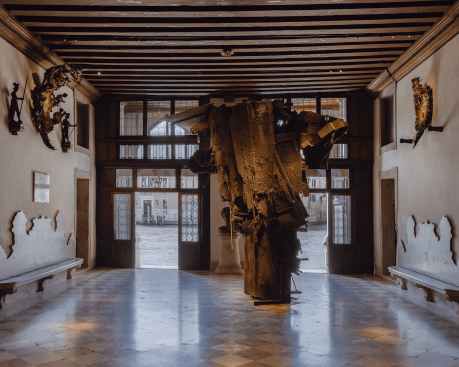
Peter Buggenhout The Blind Leading the Blind #48, 2012 Mixed media (cardboard, iron, polystyrene, polyurethane, textile, wood) covered with domestic dust Courtesy of the artist and Axel Vervoordt Gallery. Photo: Matteo de Mayda.
Against all this sense of the lush world falling to pieces the curators pose half a dozen pieces by the Belgian sculptor Peter Buggenhout, whose assemblies of cardboard, cast-off building materials, and other remnants carry the sense, if not the reality, that they are covered with dust. His The Blind Leading the Blind #48 (2012) opens the show with a larger-than-life monumental figure fused with what might be the building materials hiding within the elaborate surfaces of the building.
Throughout the display rooms that spread out over two floors, every time you find yourself drowning in the kind of beauty you might expect in a Tintoretto-like fever dream of this place, the Buggenhout’s bring you back to bare bones, bags of industrial fabric or plastic, and sticks reaming it all together. There is great mastery here, but of the kind that undresses and challenges, rather than smothering you.
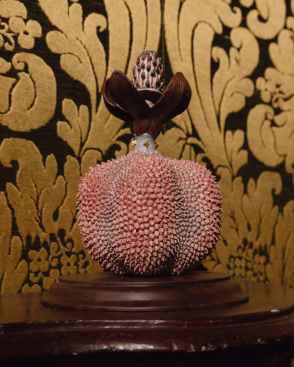
Kaori Kurihara Pierrot fleuri, 2025 Stoneware, underglaze decoration, glaze, gilding, silvering Courtesy of the artist. Photo: Matteo de Mayda.
The work of Kaori Kurihara, an artist based in Paris “whose practice explores the unsettling beauty of botany and the vegetal world,” as the wall text has it, brings this monstrous aesthetic much more directly back to the scene it is set. Here contributions are ceramic pieces, which here are on view on sconces that usually hold Venetian vases, that provide a bulbous base for flowers or plants (succulents come to mind) that do not exist except in this clay rendering.
The bulges of the undercarriage turn them into a combination of a urn and a seed pod covered with colored nibs. Placed against floriate wallpaper and lit, like everything in the exhibition, with high drama, they seemed to me the essence of everything the curators were trying to show us.
The Only True Protest is Beauty’s other work ranges from new versions of Murano glassware, as deconstructed as you might by expect from the other objects, placed among sterling examples of a more familiar sort. There are also contemporary chairs showing off their computer modeling or love of materials such as the springs hiding inside plush sofas. They are stacked in what had been a storeroom among the kinds of furniture that no doubt get pulled out when the Palazzo hosts one of its many rental parties.
To walk through the world van Noten and Bruloot have staged at Palazzo Pisani Moretta is an exhausting experience. There is no relief from the swirls and curves, bulges and bustiers, and general animation anywhere you look, especially because of so much of that is already built into the walls and (at times Tiepolo-painted) ceilings. Nor would I want it any other way.
After the messy and tourist-laden canals and alleys of Venice and the beautiful, but often pretentious work in the Biennale, this exhibition constructs, albeit in bits and pieces, an argument that craft, whether expressed in fashion, jewelry, ceramics, sculpture, painting, or any other form, and carried out with imagination, makes all that out there oddly sensible. You can feel, intuit, and just wear reality turned into beauty. What that experience does not provide is catharsis or a way out of the endless labyrinth that both Venice and art are towards something that make sense of and even changes the reality we must undergo.
Read more: The latest from columnist Aaron Betsky includes reviews of: The Revenge of the Arch | Out There | The Shakers | The V&A Storehouse | Fins on Buildings | New Museum & The Studio Museum in Harlem | The Modern Museum | Monuments | Infrastructure | Interior Design | Viollet-le-Duc | Malibu High School | Architecture without Architects | Louis Kahn’s Fisher House | Meow Wolf | Generative AI | Frank Gerhy | Robert A.M. Stern | Lars Lerup | Princeton Art Museum | Victor Legorreta | Mexico City Underwater | On Vitruvius | On Olive Development | Calder Gardens | White House and Classical Architecture | Louis Kahn’s Esherick House | Ma Yansong’s Fenix Museum | The Cult of Emptiness | An Icon in Waiting | Osaka Expo | Teamlab | the Venice Biennale of Architecture | On Michael Graves | On Censorship or Caution? | Uniformity in Architecture | Book on Frank Israel | Legacy of Ric Scofidio| Fredrik Jonsson and Liam Young | DSR’s New Book | the Stupinigi Palace | Living in a Diagram | Bruce Goff | Biopartners 5 |Handshake Urbanism | the MONA | Elon Musk’s Space X | AMAA | DIGSAU | Art Biennales | B+ | William Morris’s Red House | Dhaka | Marlon Blackwell’s new mixed-use development | Eric Höweler’s social media posts,| Peter Braithwaite’s architecture in Nova Scotia,| Powerhouse Arts, | the Mercer Museum, | and MoMA’s Ed Ruscha exhibition.
Keep the conversation going—sign up to our newsletter for exclusive content and updates. Sign up for free.